Common Steam System Problems - and How to Prevent Energy Loss
15.06.2026
When I first enter an industrial facility to conduct an energy efficiency audit, I'm often greeted by the same sight: clouds of steam rising above the roof, hissing noises from the distribution combs, and operators who are accustomed to dismissing these phenomena as normal work processes. In reality, steam is one of the most expensive heat transfer fluids in production, and any unintended evaporation or leak directly burns the company's budget. This practical guide was created to help technicians promptly detect hidden defects and systematically address common steam system problems, thereby regaining control over energy costs.
Today we’ll cover:
- The most common causes of steam energy loss in industrial systems;
- How steam leaks, failed steam traps, poor insulation, and condensate problems reduce efficiency;
- Warning signs that indicate your steam system is wasting energy;
- Practical troubleshooting and maintenance strategies to improve steam performance;
- Includes real-world examples, prevention tips, and energy-saving recommendations.
What Causes Energy Loss in Steam Systems?
Steam system energy loss is commonly caused by leaks, failed steam traps, poor insulation, and inefficient condensate recovery, all of which reduce industrial efficiency and increase operating costs. 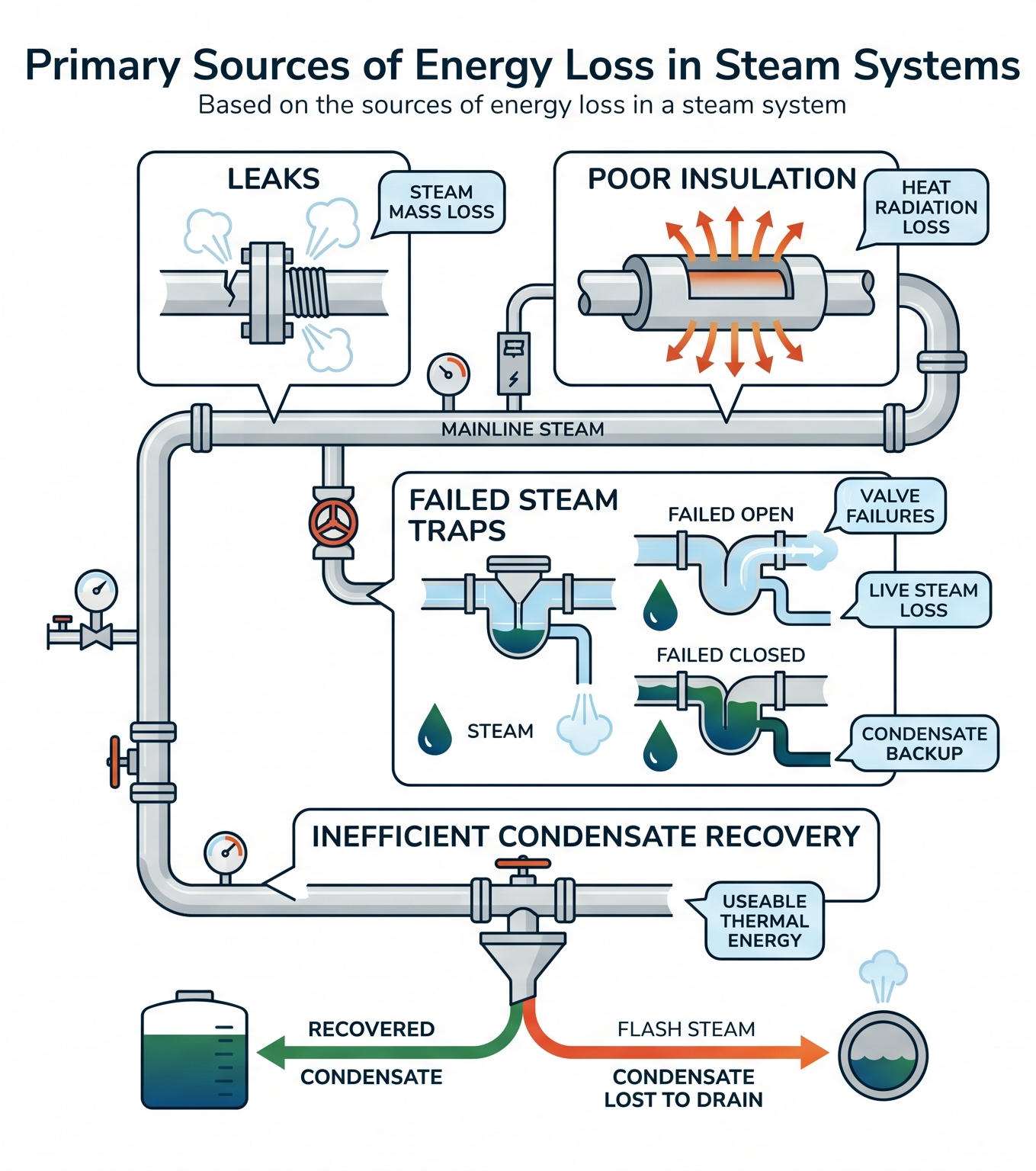
Frequent maintenance issues include:
- Mainline leakage occurs due to loose connections from piping system components, worn valve seals, or defects in the pipe’s thermal insulation. As a result, continuous cooling of the pipe creates excessive amounts of condensate;
- Defective steam traps cause problems by improperly operating as drain units, which leads to either excessive steam leakage or the flooding of equipment downstream;
- Failure to recover hot condensate through a re-use process affects the overall performance of the steam system because of the loss of usable thermal energy associated with hot condensate.
To minimize these factors, engineers use comprehensive steam system solutions that automate monitoring and protect the system from critical wear. The gradual accumulation of minor maintenance defects over time escalates into large-scale losses, increasing the cost of finished products.
Why Steam System Efficiency Matters
In a highly competitive market, energy costs account for a significant portion of the cost of any industrial product. When a steam system operates at its peak efficiency, the company faces a host of hidden costs that directly impact its financial performance.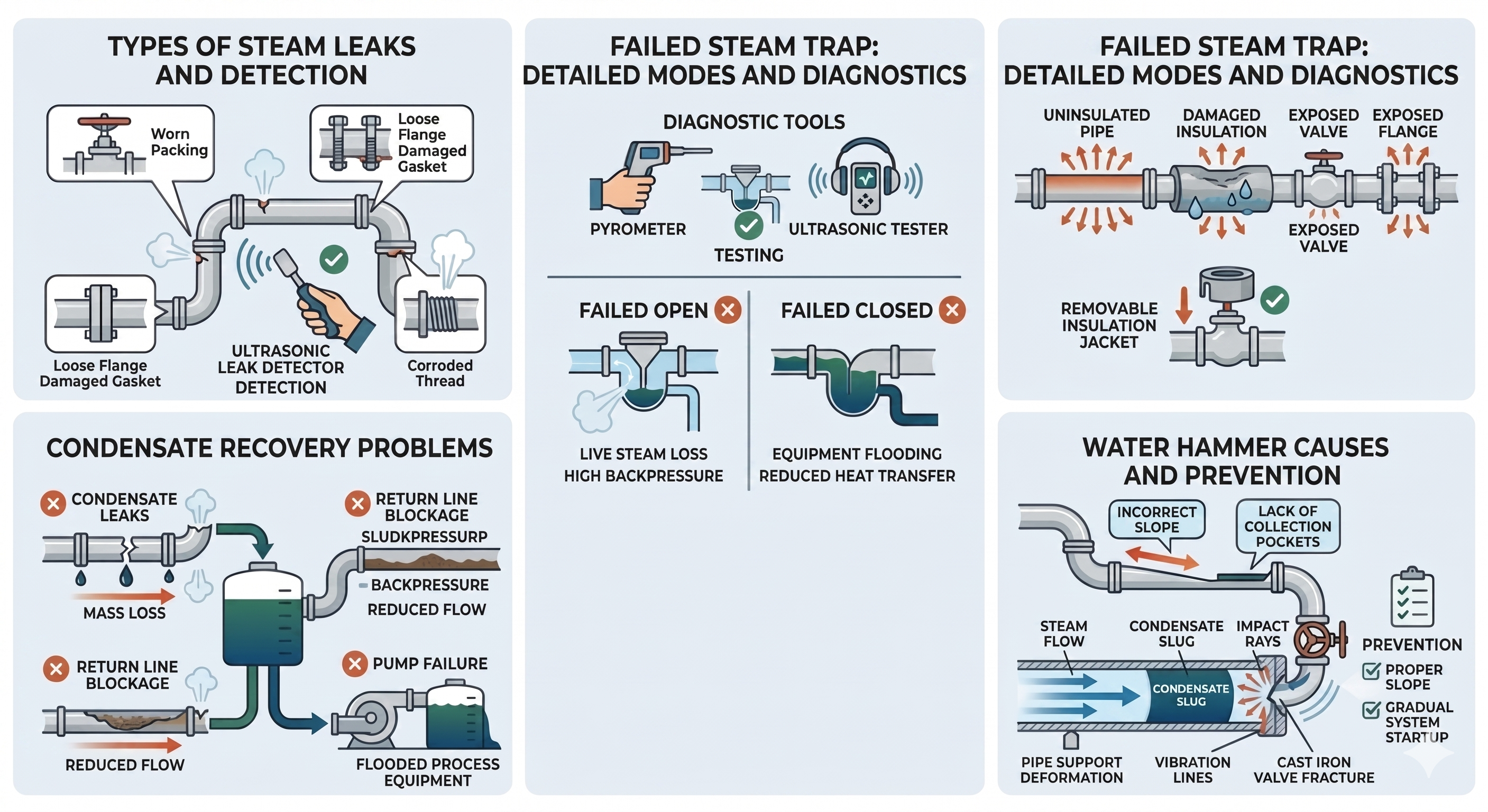
Here's why you need to maintain high levels of industrial steam efficiency:
- Rising fuel costs. Continuously rising prices for gas, fuel oil, and coal force the search for ways to reduce specific resource consumption;
- Process stability. Unstable steam parameters cause temperature fluctuations in equipment, which directly lead to increased defective products;
- Equipment reliability. A constant excess of condensate causes accelerated pipe corrosion and premature failure of control valves;
- Environmental burden. Excessive fuel combustion increases carbon dioxide emissions, leading to fines for violating environmental regulations;
- Operational efficiency. Continuous emergency shutdowns to repair leaks distract the maintenance crew from scheduled plant maintenance.
Field insight: Even small steam losses become expensive very quickly in systems running 24/7.
Steam Leaks – The Most Common Energy Loss Problem
Steam leaks through piping components are the most visible and, at the same time, the most ignored problem in most plants. A constant hissing sound in the workshop is often perceived by personnel as an unavoidable background noise.
Let's look at the causes:
- Worn packing. Loss of seal on manual gate valve and control valve stems due to drying out of the packing;
- Flanged connections. Loosening of bolts due to constant temperature cycles and deformation of gaskets;
- Thread damage. Corrosion and mechanical wear of impulse line connections and pressure sensors;
- Weld failure. Microcracks at connection points due to vibration and thermal expansion.
Any unplanned steam leaks in industrial systems lead to an immediate drop in pressure in dead-end sections of the pipeline. In addition to the direct loss of coolant mass, leaks pose a serious hazard to maintenance personnel, as the jet of superheated, high-pressure steam is visually invisible but can cause severe injuries. The primary methods for combating this phenomenon include regular inspections with portable ultrasonic leak detectors and the timely replacement of worn seals during scheduled plant shutdowns.
Failed Steam Traps and Their Impact
The steam trap plays a vital role: it must retain steam in the heat exchanger until it completely releases the latent heat of vaporization, and promptly remove the resulting condensate and air.
Here's what can happen:
- Continuous open mode. The trap valve becomes stuck open, turning the device into a through-pipe through which hot steam escapes into the return line;
- Continuous closed mode. The internal mechanism becomes locked closed, completely stopping the removal of liquid from the equipment;
- Sludge clogging. The accumulation of scale and corrosion products on the valve seat impairs the seal;
- Mechanical wear. Abrasion of the internal levers of float-operated models or destruction of the disks of thermodynamic devices.
When a hidden steam trap failure occurs, the consequences depend on the nature of the failure. When stuck open, the system instantly loses a significant portion of its thermal energy, and the pressure in the condensate line increases, blocking the operation of adjacent traps. If the unit is closed, condensate begins to accumulate inside the heat exchanger, dramatically reducing the effective heat transfer area and causing dangerous hydraulic shocks. Prevention involves establishing a strict testing schedule for components using pyrometers and ultrasonic testing devices.
Poor Insulation and Heat Loss
Even if your system is completely free of physical leaks, heat energy can escape through the pipe surface without a trace if it is not properly protected.
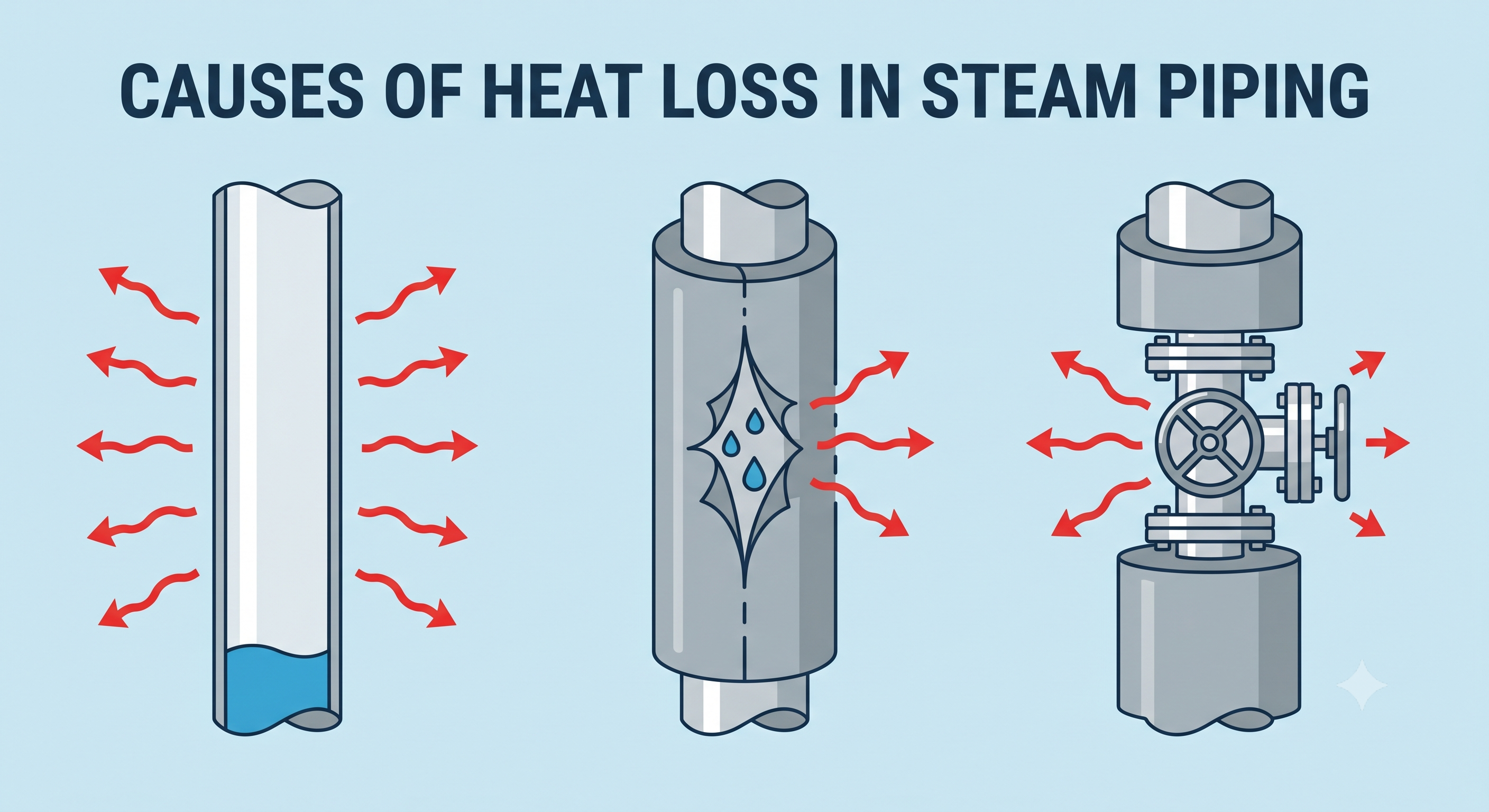
The most common causes are:
- Uninsulated pipes. Constant cooling of the pipe walls leads to a dramatic drop in steam dryness and overload of drainage points;
- Damaged insulation. Wet mineral wool due to leaks or damaged protective jackets completely destroys the insulation's heat-retaining properties;
- Exposed valves and fittings. The bodies of valves, filters, and control valves, as well as flange pairs, are often left exposed after maintenance, turning them into powerful heat loss points.
Every square meter of uninsulated high-pressure pipe generates a constant heat flow into the surrounding environment. This latent steam energy waste forces the boiler to burn more fuel to maintain the consumer's design parameters. Furthermore, when steam piping systems lack insulation, condensation develops along the main piping, resulting in low-quality steam and places excessive demands at the points of condensation drainage.
Condensate Recovery Problems
Condensate is a valuable resource, containing up to 25% of the original thermal energy of steam. Furthermore, it is an ideal distillate, having already undergone the expensive deaeration and chemical treatment process in the boiler room.
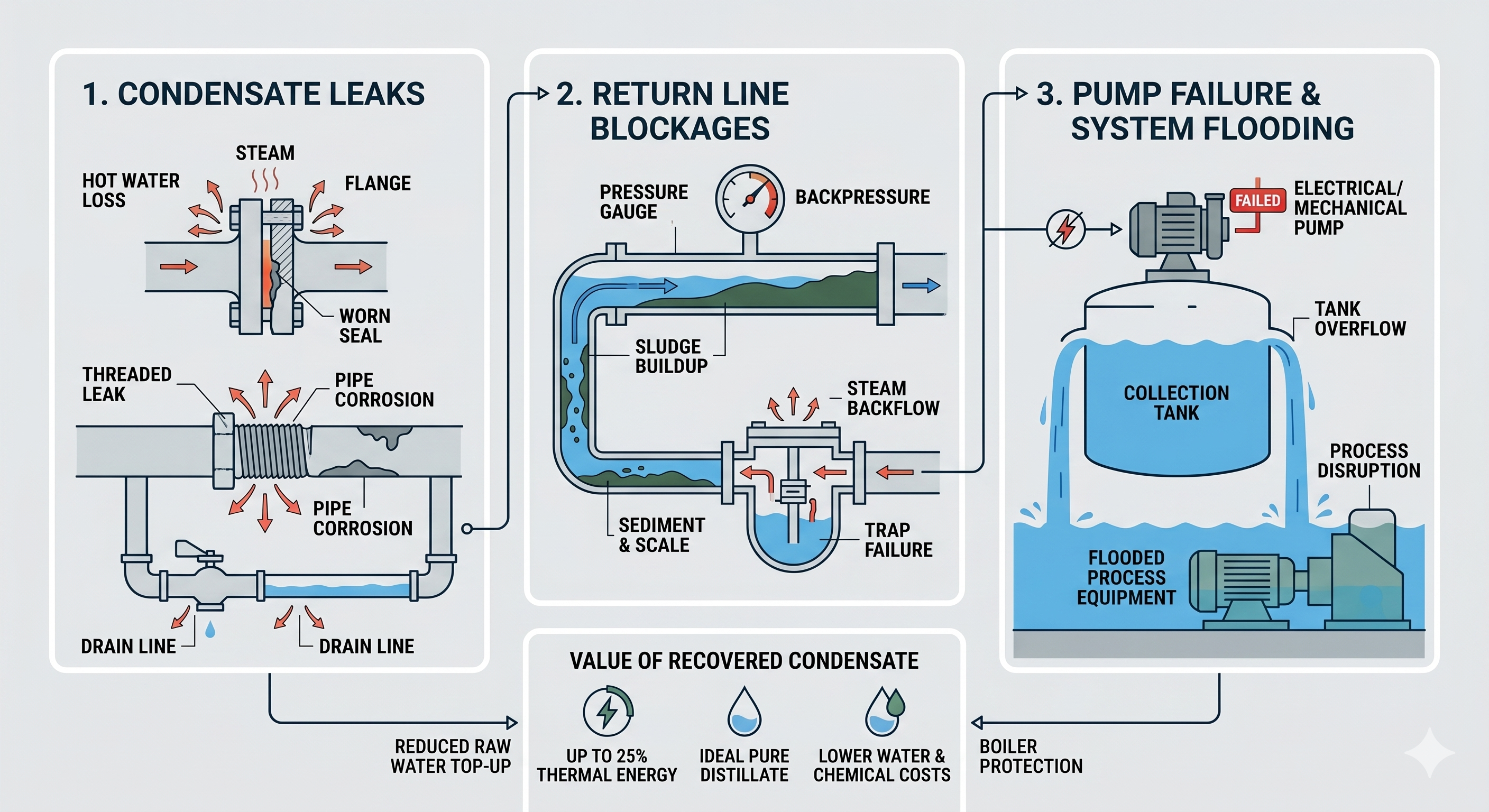
Recovering condensate improves steam system efficiency by reducing energy, water, and chemical treatment costs.
Let's consider the following potential problems:
- Condensate leaks. Hot water loss through worn flanges, threaded connections, and leaks in drain lines;
- Return line blockages. Main line blockages due to sludge buildup or backpressure caused by steam backflow from faulty traps upstream;
- Condensate pump failure. Failure of mechanical or electrical pumping stations causes collection tanks to overflow, and liquid begins to flood process equipment.
Understanding how to reduce steam loss by optimizing condensate return can radically change the economics of a plant. Every litre returned reduces the need for raw water top-up and reduces the consumption of expensive chemical reagents to protect the boiler from scale.
Pressure Problems in Steam Systems
Proper selection of operating pressure at various points in the system is the foundation for the stable operation of process lines. High pressure is beneficial for transporting steam throughout the plant, as it reduces the required pipe diameter, but at the consumer, the pressure must be reduced to the optimal process level.
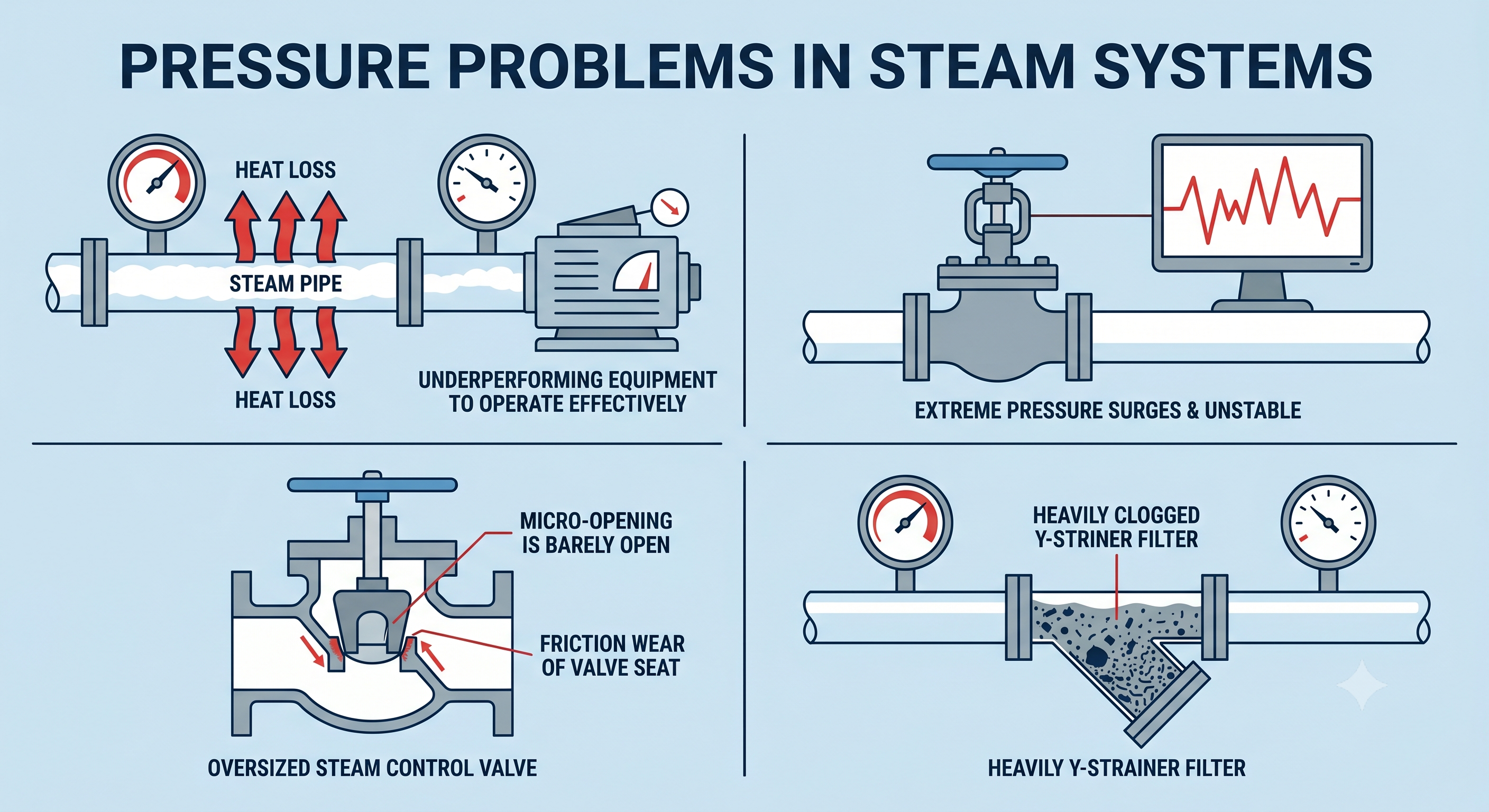
Several potential problems:
- Incorrect pressure settings. Selecting excessively high parameters increases heat loss through the pipe walls, while too low a pressure prevents the process equipment from reaching its design capacity;
- Unstable pressure control. Constant pressure surges due to failures in the automation circuits disrupt process stability, causing temperature fluctuations and increasing the risk of product defects;
- Oversized pressure regulators. Using control valves with excessive flow capacity forces them to operate in a micro-opening mode, which leads to rapid seat wear and loss of flow control;
- Pressure drops across the system. High hydraulic resistance due to incorrectly calculated pipe diameters or clogged filters critically reduces steam pressure at the end consumer.
When a plant lacks a systematic approach to parameter control, comprehensive industrial steam system optimization is impossible. Unstable pressure disrupts heat transfer in equipment, leads to excessive energy consumption, and increases the risk of water hammer due to changes in the velocity of the steam-condensate mixture.
Using
Water Hammer and Condensate Buildup
Water hammer is one of the most dangerous physical processes occurring within a steam pipeline. It occurs when accumulated condensate is picked up by a high-velocity steam flow and slams into pipe bends, valves, or process equipment at high speed.
What can go wrong:
- Incorrect slope. Steam pipelines are installed with a slope opposite to the steam flow, which interferes with natural drainage;
- Lack of collection pockets. Failure to install deep condensate collection points before vertical rises in the pipe;
- Abrupt system startup. Rapid opening of main steam valves on a cold main without preheating;
- Insufficient drainage. Clogged impulse tubes or filters before automatic liquid drainage points.
Constant vibrations and dull thuds within the network indicate a critical water accumulation in the system. The consequences of this phenomenon are always devastating: from deformation of pipeline supports to complete rupture of cast iron valve bodies and filters, which poses a direct threat to the safety of people nearby.
Air and Non-Condensable Gases in Steam Systems
When starting a cold system, all pipelines are filled with air, which must be completely removed. If this is not done, the gases mix with steam and create an insulating layer on the heat transfer surfaces.
Issues you can face:
- Air locks. Accumulation of non-condensable gases at the high points of heating jackets and coils;
- Temperature drop. Air reduces the partial pressure of the steam, causing the actual mixture temperature to be significantly lower than the design temperature;
- Corrosivity. Oxygen and carbon dioxide, when dissolved in condensate, form aggressive acids that attack metal;
- Failure of automatic air vents. Failure of thermostatic gas vent valves installed in dead-end sections.
Even a small amount of air inside the digester can increase the product heating time several times. The system begins to consume more coolant, but the actual heat transfer efficiency decreases, creating zones of uneven heating.
Common Steam System Problems – Comparison Table
Most steam system energy losses come from a small number of recurring maintenance and operating problems.
Problem | Impact | Typical Symptoms | Prevention Method |
Steam leaks | Direct loss of steam mass, system pressure drops, personnel safety hazards. | Visible steam plumes, distinct hissing at flanges and valve stems. | Regular pipeline walkthroughs, ultrasonic leak detection, scheduled flange tightening. |
Failed steam traps | Live steam blowing through or flooding of process equipment. | Pressure increase in the return line and prolonged process heat-up times. | Semi-annual instrumental steam traps check. |
Insulation damage | Increased radiant heat loss and reduced steam dryness fraction. | Destroyed cladding and high ambient air temperature in the workshop. | Regular insulation integrity checks and installing removable thermal jackets. |
Condensate loss | Excessive fuel consumption and increased water treatment costs. | Heavy steam venting from condensate receiver flash pipes. | Upgrading condensate return pumping stations and eliminating cavitation. |
Pressure variability | Changed heat transfer and increased number of product defects. | Fluctuating pressure gauges and erratic control valve functions. | Correctly sized Kv valves and routine cleaning of the impulse sensing line. |
Water hammer | Mechanical damage to valve bodies and deformities in pipe supports. | Sound of loud banging and serious pipe vibrating during the start-up of systems. | Following the correct slope of the pipeline and gradually warming up the system. |
Real-World Examples from Industrial Plants
I have provided several examples of how hidden issues can negatively influence enterprise economics in engineering. I have also demonstrated how quickly a business can reap economic rewards by eliminating these types of problems.
Food processing facility
At the dairy plant, the time it takes for the pasteurizer to warm up has increased by almost 100%, leading to disruptions in the shipping schedule. Upon performing diagnostics, I found that the steam traps at the outlet of the pasteurizers have been replaced by cheaper thermodynamic models that do not work for the same volume of condensate when initially starting up, resulting in constant flooding of the heat exchangers and one of the traps having its internal valve stuck in the open position. I replaced the thermodynamic traps with float-type steam traps that were used as originally designed, which resulted in heat transfer rates being restored and the total steam usage for the plant being reduced by 9% immediately.
Chemical plant
An audit of the main pipelines at a chemical plant revealed that approximately 300 meters of elevated steam pipelines had suffered significant damage to the insulation layer after repairs, while flange assemblies and control valves remained completely exposed. Pyrometer measurements revealed a metal surface temperature of approximately 175°C. The installation of modern mineral wool insulation and quick-release protective covers on the valves reduced radiant heat loss, reducing the load on the boiler room and ensuring a return on material costs in just three months of operation.
Manufacturing plant
At a construction materials plant, hot condensate from presses simply drained into an open sump, from where it was pumped into the sewer system, as the old electric pumping station was constantly failing due to cavitation. The plant was incurring colossal losses when purchasing cold water and reheating it in the boiler. We reconstructed the unit and installed a closed mechanical pumping station that uses the steam pressure itself as the driving force. This allowed us to return 85% of the high-temperature water to the boiler room and reduce gas costs by 14%.
Steam distribution network
The industrial site's extensive steam network experienced constant water hammer, regularly knocking out gaskets on the main flanges. The cause was improper geometry of the distribution manifold: the required slope was not maintained during installation, and the automatic drainage points were too far apart. After adjusting the pipe slope, installing deep condensate collection pockets, and installing new steam traps, the system became completely silent, and emergency repair crews ceased calling.
How I Troubleshot the Steam System Energy Loss
When I visit a site to search for hidden losses, I never try to check everything at once. I need a clear, step-by-step algorithm that allows me to quickly isolate the most costly defects.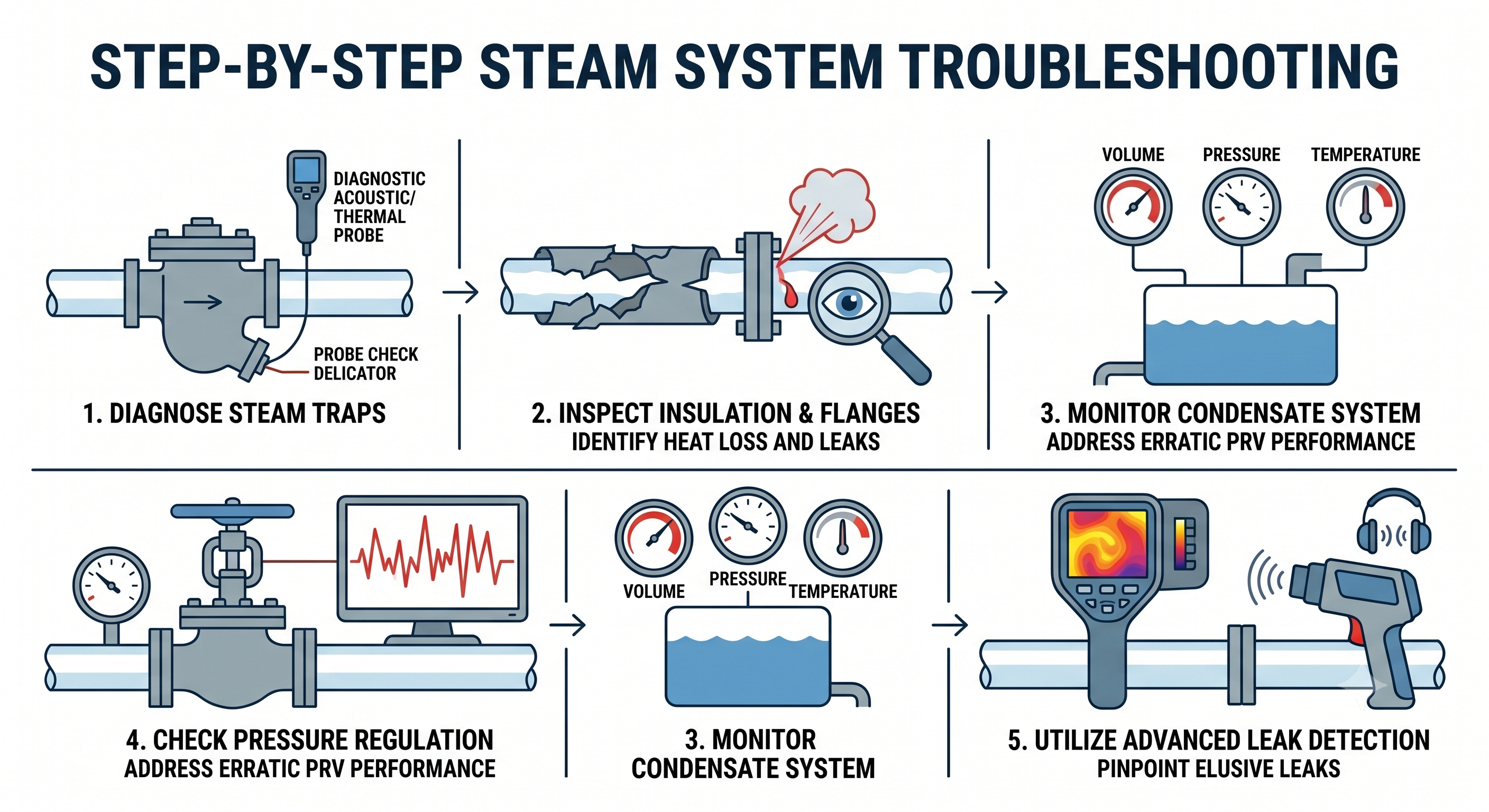
My practical approach to steam system troubleshooting always moves from obvious problems to hidden system failures:
- Steam trap inspection. I assess the condition of condensate drainage units using diagnostic tools to identify stuck valves;
- Checking for leaks and insulation damage. I visually inspect the main lines to detect leaks on flanges and find exposed sections of fittings that act as radiators;
- Monitoring condensate return performance. I monitor the volume, pressure, and temperature of the return water at the main boiler house collection point;
- Reviewing pressure stability. I analyze pressure gauge readings to identify self-oscillations, pressure drops, and incorrect operation of pressure-reducing valves;
- Using thermal imaging and ultrasonic tools. I use a thermal imager to pinpoint areas of increased heat radiation and a portable ultrasonic leak detector to precisely locate leaks in closed circuits.
Best Practices for Preventing Steam Energy Loss
Reducing energy losses in steam systems requires a shift from emergency response to a systematic approach. Well-designed steam system maintenance helps maintain maximum equipment efficiency and avoid unnecessary fuel costs:
- Preventive maintenance schedules. Regularly scheduled maintenance helps identify and correct minor problems before they develop into critical steam losses;
- Steam trap monitoring programs. Continuous monitoring of steam traps allows for the rapid detection of hidden steam leaks and the prompt replacement of damaged components;
- Insulation inspections. Periodic line walkthroughs and restoration of protective covers, including the installation of thermal covers on valves, minimize radiation losses;
- Condensate recovery optimization. Efficient hot water collection and return to the boiler directly reduces the cost of purchasing fresh water and fuel for the boiler;
- Pressure control verification. Regular testing of control valves and pressure gauges helps maintain stable pressure and protects the system from overloads;
- Operator training. Training employees in soft start-up procedures and rapid troubleshooting completely eliminates the risk of water hammer and improves work safety.
How Smart Monitoring Improves Steam Efficiency
Modern IoT-enabled steam systems have taken resource allocation control to a fundamentally new level. With comprehensive SCADA integration, your dispatchers will have complete visibility into all processes in real time, while specialized energy monitoring platforms will accumulate data for in-depth auditing and the identification of hidden steam system energy loss.
Here are the features you'll get:
- Digital steam monitoring. Continuous monitoring of environmental parameters using digital sensors will completely replace outdated manual inspections;
- Predictive maintenance. Analysis of accumulated process data will allow your specialists to predict network element failures and plan maintenance work before emergencies;
- Remote diagnostics. Specialists will be able to remotely assess the performance of distributed nodes and identify thermal anomalies without on-site visits;
- Steam flow measurement. Continuous monitoring of steam consumption at each site will help accurately allocate costs between workshops and record commercial losses;
- Automated alarms. Instant automatic notifications of parameters exceeding established critical limits will allow operators to immediately respond to any failures.
Benefits of Improving Steam System Efficiency
Improving steam system efficiency reduces energy waste, lowers operating costs, and improves industrial process reliability.
Comprehensive optimization of steam and condensate circuits will bring benefits to your company that extend far beyond simple fuel savings. Equipment modernization and stabilization of operating parameters will create a synergistic effect that will positively impact all aspects of the production chain:
- Lower energy costs. Direct reduction in fuel consumption and makeup water costs due to leak elimination and efficient heat recovery;
- Improved process reliability. Stable pressure parameters and high steam dryness ensure strict adherence to process temperature regimes;
- Reduced downtime. Minimization of the risk of unscheduled process line shutdowns due to the timely detection and elimination of hidden defects;
- Lower maintenance expenses. Reduction in operating costs for repairs and valve purchases due to the prevention of water hammer and corrosion;
- Reduced environmental impact. Reducing fossil fuel combustion automatically reduces greenhouse gas emissions.
FAQs About Steam System Problems
1. What causes steam energy loss?
The main causes of losses are leaks through valve leaks, damaged pipe insulation, and improper operation of steam traps. Energy is also lost when hot condensate is discharged into the drain and flash steam is released into the atmosphere.
2. How do failed steam traps waste energy?
If a steam trap becomes stuck open, it will leak "live" steam directly into the return line. This will lead to a drop in pressure upstream of the consumer, overloading the boiler, and a sharp increase in fuel costs.
3. What is water hammer in steam systems?
Water hammer occurs when condensate accumulated in pipes is caught by a high-speed steam flow, forming a water lock. This lock, at high speed, crashes into bends in the pipeline or into valves, causing severe vibrations and mechanical damage.
4. Why is condensate recovery important?
Condensate return allows high-temperature distillate to be returned to the boiler room, while preserving up to 25% of the steam's thermal energy. This significantly reduces the costs of purchasing fresh water, chemically treating it, and reheating it from scratch.
5. How do I detect steam leaks?
Portable ultrasonic leak detectors and thermal imagers are used to detect leaks in existing pipelines. Large leaks can be detected visually by steam clouds or audibly by a characteristic hissing sound.
6. How often should steam traps be inspected?
Under standard conditions, inspections are recommended at least twice a year – before the start of the heating season and after its completion. For critical high-pressure components, monthly inspections are recommended, or a continuous digital monitoring system should be installed.