How to Align Photoelectric Sensors for Long-Range Detection (Step-by-Step Field Guide)
17.03.2026
Tuning optical sensors at long ranges is a job that requires the precision of a sniper. When the transmitter and receiver are 10, 20, or 30 meters apart, any one-degree misalignment of the bracket can shift the light spot tens of centimeters from the target. Over the years of working as a systems integrator and service engineer on automated warehouses and packaging lines, I've learned one golden rule: if you've simply "caught the signal" and seen the light come on, your job isn't done yet. A system tuned to the brink of failure will inevitably fail within a week due to dust, vibration, or seasonal metal expansion. True professional tuning requires a substantial safety margin that will allow the automation to operate for years without your intervention. Today, we will learn how to align a photoelectric sensor.
In this article, we will also cover:
Step-by-step alignment process for long-range photoelectric sensors;
Differences between thru-beam, retroreflective, and diffuse alignment;
How to maximize detection distance and signal stability;
Common alignment mistakes that cause missed reads;
Field-tested troubleshooting and setup checklist.
Why Proper Alignment Matters in Long-Range Detection
In the world of industrial automation, photoelectric sensor alignment is the foundation upon which the reliability of the entire line is built. While at short distances of up to half a meter, the light beam is wide enough to cover minor imperfections in a crooked bracket, at greater distances, the inexorable geometry and physics of wave propagation come into play.
Failing to hit the receiver's center causes the sensor to be at its maximum limit; any dust/steam in the workshop will immediately drop the signal, and the object will be counted as "not there". A long beam is like a lever, and just moving the motor at the base even slightly makes the spot of light dance violently at the end of the beam. Also, the thermal expansion of the metal can push the posts apart in the winter or summer. When the long-distance photoelectric sensor is not set up correctly, the overall consequence will be actual losses, making mistakes in counting, or constantly trying to "find" the lost signal during the shift due to excessive downtime.
Types of Photoelectric Sensors and Their Alignment Differences
Every optical design has its pitfalls. I never use the same technique for a high-power barrier and a conventional reflective sensor.
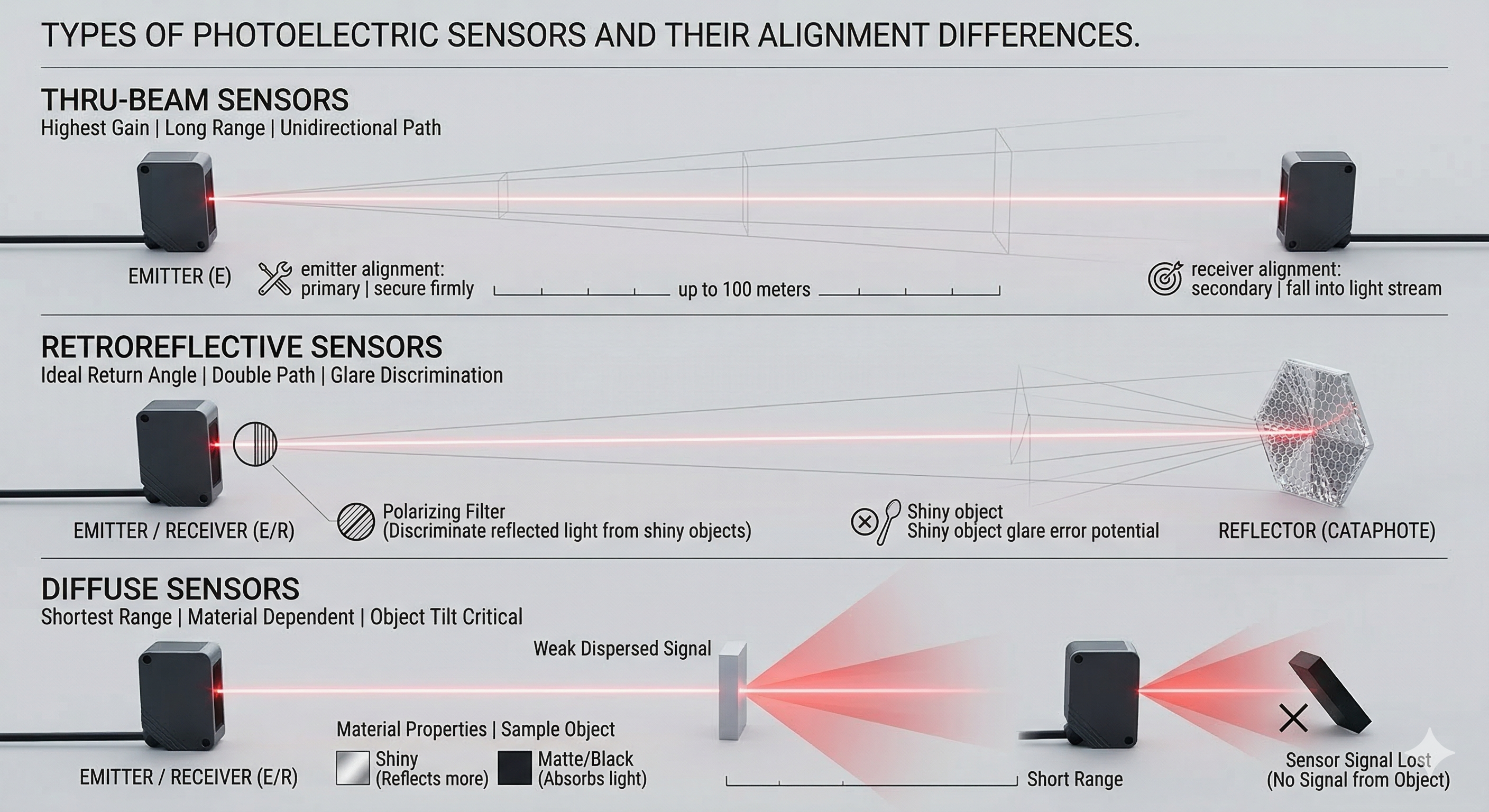
- Thru-beam sensors
This system consists of two separate active devices: an emitter and a receiver. It's the undisputed leader among long-range object detection sensors, capable of operating at distances of up to 100 meters.
I start by installing the emitter. It's important to secure it as firmly as possible, as it forms the light corridor. Receiver alignment is secondary – it simply needs to "fall" into the created light stream.
Since the light travels only one way, this system has the highest excess gain, allowing it to ignore even heavily contaminated optics.
For reliable long-range detection, I frequently rely on industrial-grade models like the Pepperl+Fuchs M100/MV100 Thru-beam sensor. Its highly visible light spot and full metal thread mounting make it incredibly easy to align and resistant to ambient light interference.
- Retroreflective sensors
Here, the emitter and receiver are located in the same housing, and a passive reflector (cataphote) must be installed on the opposite side. High-quality retroreflective sensor alignment is more difficult than it seems, as the beam travels twice.
I always choose models with polarizing filters. They allow the sensor to distinguish reflected light. If you align a standard retroreflective sensor with a shiny object, it may "miss" it and mistake the glare for a signal from the reflector.
When dealing with tricky environments, you need optics that won't let you down. Models like the
- Diffuse sensors
For diffuse models, the emitter and sensor are located in one housing, and the beam must reflect directly from the surface of the item. This design also has the shortest detection range due to light being dispersed in every direction. When adjusting the diffuse sensor, I use the characteristics of the material to determine how much light will be absorbed by materials that are either black or matte. When positioning an object with respect to the sensor, if it is tilted at an angle to the sensor, the reflected beam may not return to the sensor, and, as a result, the sensor would have no signal from the object.
If you need a dependable diffuse solution, consider the
Step-by-Step Alignment Procedure (Field Method I Use)
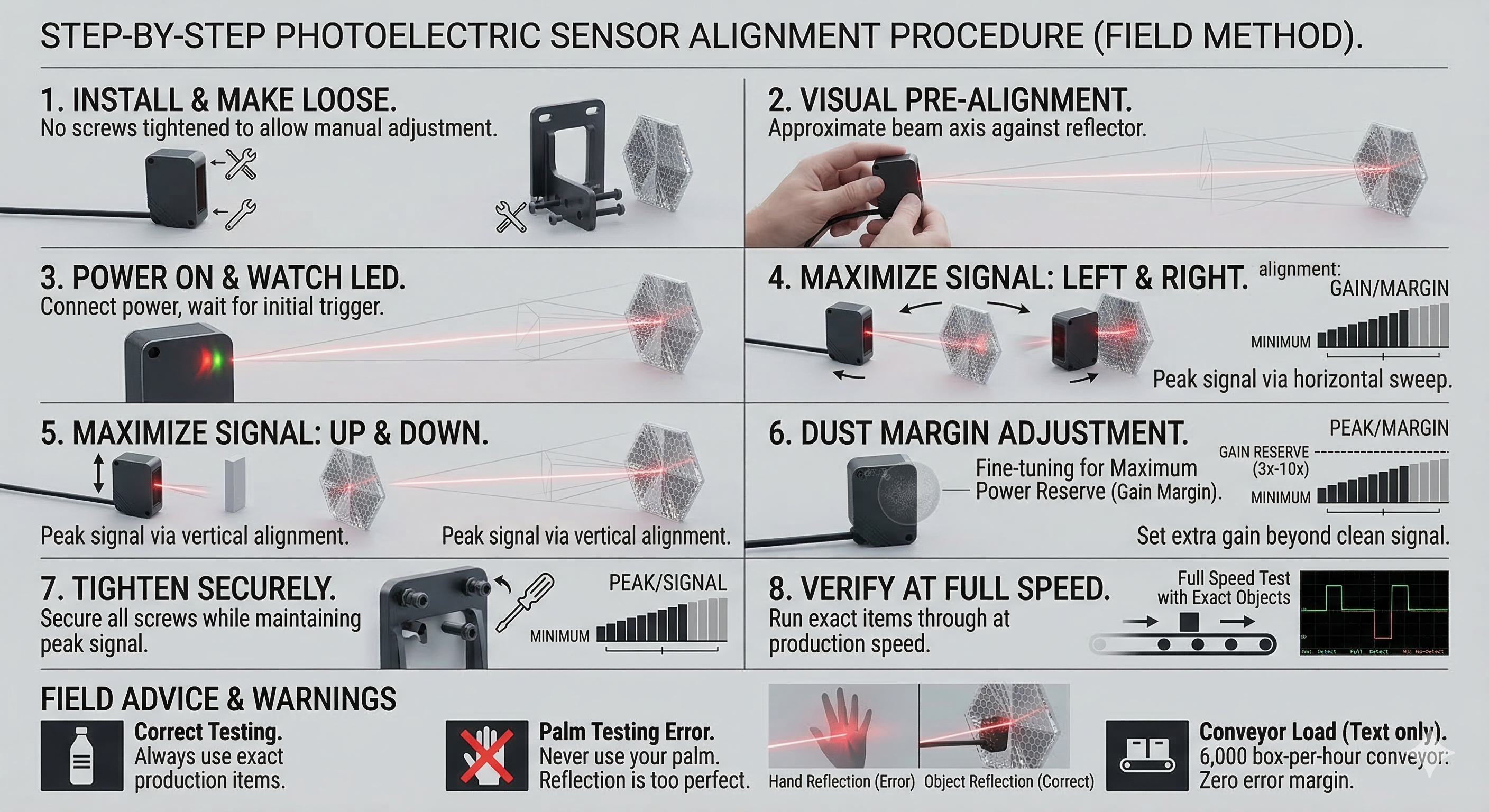
When I'm tasked with performing a long-range photoelectric sensor setup at a facility where the cost of error is stopping a 6,000-box-per-hour conveyor, I follow a strict protocol:
Make the sensor loose. I do not screw down any of the screws at the first stage of installation to allow for adjustment of the sensor's position by hand to get accurate alignment;
Get the sensor in the right place. I line up the sensor with the target or reflector using only visual means for an approximate alignment of the beam axis;
Turn power on & watch the LED. I then put the power on and watch the signal LED or learning LED to see when the receiver "sees" the emitter;
Move the sensor left & right. I slowly turn the sensor left and right until I achieve the maximum signal level;
Move the sensor up and down. I then adjust the height of the sensor to achieve maximum response from the sensor and the most stable operation;
Adjust the sensor for dust. I fine-tune the sensor's setting for maximum signal strength to allow for proper function, even when the lens is dirty;
Tighten all mounting screws. I tighten all of the mounting screws, ensuring that the sensor remains in the same place and that I have maximum signal level;
Verify operation at full speed. Finally, I verify the operation of the sensor (for example, by testing an object moving on the conveyor at full speed).
My advice: Never test the system with your palm. The hand reflects the light too perfectly; always use the exact objects that will be moving along the line for testing.
Maximizing Long-Range Performance
To ensure that optics perform at their best, external factors that "steal" photons must be taken into account:
Keep the beam perpendicular. I always try to keep the beam strictly perpendicular to the reflector or object surface, as a deviation of more than 15 degrees dramatically reduces the detection range;
Avoid reflective backgrounds. If there is shiny metal or a glossy wall behind the object, I tilt the detector at a slight angle to avoid unwanted reflections;
Use proper reflector size. At long distances, I never skimp on reflectors and choose larger reflectors, as small reflectors simply cannot return enough light;
Shield from direct light. I always use visors or lens hoods if there are bright spotlights or sunlight from windows in the workshop that could blind the receiver;
Account for vibration. To compensate for mechanical drift, I use only heavy-duty brackets and periodically check the alignment, especially if the equipment is operating at high speeds.
Common Alignment Mistakes I See in the Field
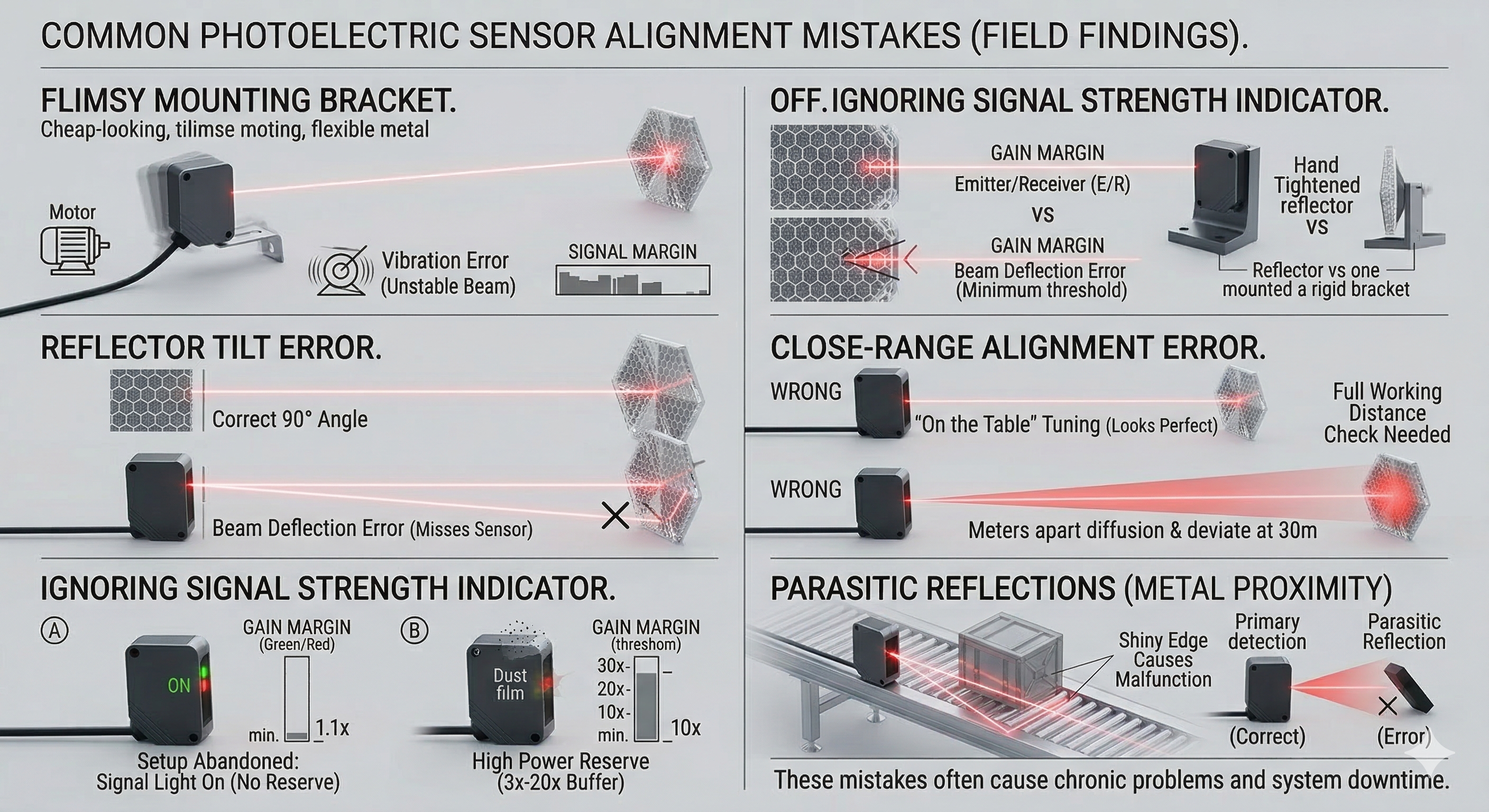
A poor photoelectric sensor installation guide often causes chronic problems on line. Here are the top mistakes I correct most often:
The mounting bracket is too flexible. I often see technicians using flimsy metal brackets that vibrate under any motor, causing the beam to wander off-target;
Reflector slightly tilted. Even a slight tilt of the reflector deflects the return beam away from the lens, which is often mistaken for a faulty sensor;
Ignoring the signal strength indicator. Many beginners abandon the setup as soon as the detection light comes on, not caring about the power reserve in case of dust buildup;
Aligning at a short distance. A big mistake is adjusting the sensor "on the table" without checking how the light spot behaves at the full working distance;
Installing too close to metal. Mounting the sensor close to the shiny edges of the frame often causes parasitic reflections, causing the automation to malfunction for no apparent reason.
Signal Strength and Stability – What to Look For
When performing thru beam sensor alignment, I always look for the so-called Gain Margin:
LED intensity behavior. I always monitor the stability indicator: it should glow steadily and brightly, not flicker on the verge of triggering;
Stability during vibration. I always check the signal dynamically – if the indicator starts to flicker when adjacent motors are running, it means the beam is not centered and will soon drift;
Check the margin by blocking the beam. To ensure reliability, I partially block the lens with cardboard – if the sensor continues to reliably detect the target, the system has a good margin for contamination;
20-30% margin critical. I never submit a job without this power reserve, as it is this extra percentage that prevents the line from stopping when the first dust settles on the optics.
Troubleshooting Weak or Inconsistent Detection
When the connection becomes unstable, I perform deep photoelectric sensor troubleshooting following this logic.
- The sensor works intermittently
This is a classic sign of mechanical drift. Check the tightening of the screws – constant vibrations often cause the bracket to slowly "slip." Also, check the lenses: an oil film or condensation can refract the beam, causing it to drift off-axis. Another cause is voltage drop. On long cable runs, when powerful drives are turned on, the 24V voltage can drop to 18V, which is insufficient for the sensor's powerful LED.
- False triggers
If the sensor is triggered when there's no object present, look for glare. This could be a reflection from the floor, ceiling, or a passing forklift. In reflective systems, check that the reflector isn't angled so that it's reflecting light from an adjacent sensor.
- Reduced range over time
If the sensor used to be capable of detecting 10 meters, but now barely reaches 5, this indicates wear or contamination. Polycarbonate lenses become cloudy over time from the harsh chemicals used in cleaning equipment. Cheap sticker reflectors lose their properties over time due to humidity.
Mounting and Mechanical Stability Tips
Proper mounting is the way to successful aligning industrial photoeyes:
Use rigid brackets. For long-range work, I always choose heavy-duty steel brackets, because any flimsy metal piece on a 10-meter arm turns the beam into a chaotic flashlight;
Add vibration damping. If I'm installing the sensor on a high-speed line with powerful drives, I always use rubber pads or dampers to eliminate high-frequency vibration that can disrupt the optics;
Avoid overtightening. I never tighten the nuts on plastic housings until they snap, as this can deform the internal lens and permanently throw off the sensor's focus;
Recheck after the first cycle. I always recheck the setup after the first hour of line operation – this is the only way to ensure that vibration and heat haven't dislodged anything.
Environmental Factors That Affect Long-Range Detection
The external environment in a workshop can quickly destroy even a perfectly tuned sensor if it isn't prepared for harsh conditions in advance:
Dust accumulation. I always consider that a layer of dust on the lens acts as a filter, so when setting it up, I leave a significant power reserve to ensure the signal doesn't fade after a couple of shifts;
Steam or fog. In areas with steam or fog, I try to use the most powerful emitters that can penetrate the suspended particles without losing stability;
Temperature expansion. I remember that seasonal metal expansion in the hangar can imperceptibly move the sensor rack a couple of centimeters to the side, so I choose only the most rigid mounting points;
Direct sunlight interference. To prevent the sun or powerful spotlights from blinding the receiver, I always install protective visors or shades over the optics;
Shiny surfaces are causing beam bounce. I always check that there is no glossy floor or shiny frame nearby, from which the beam could be reflected and hit the receiver by "ricocheting", going around the object.
Real-World Examples from the Field
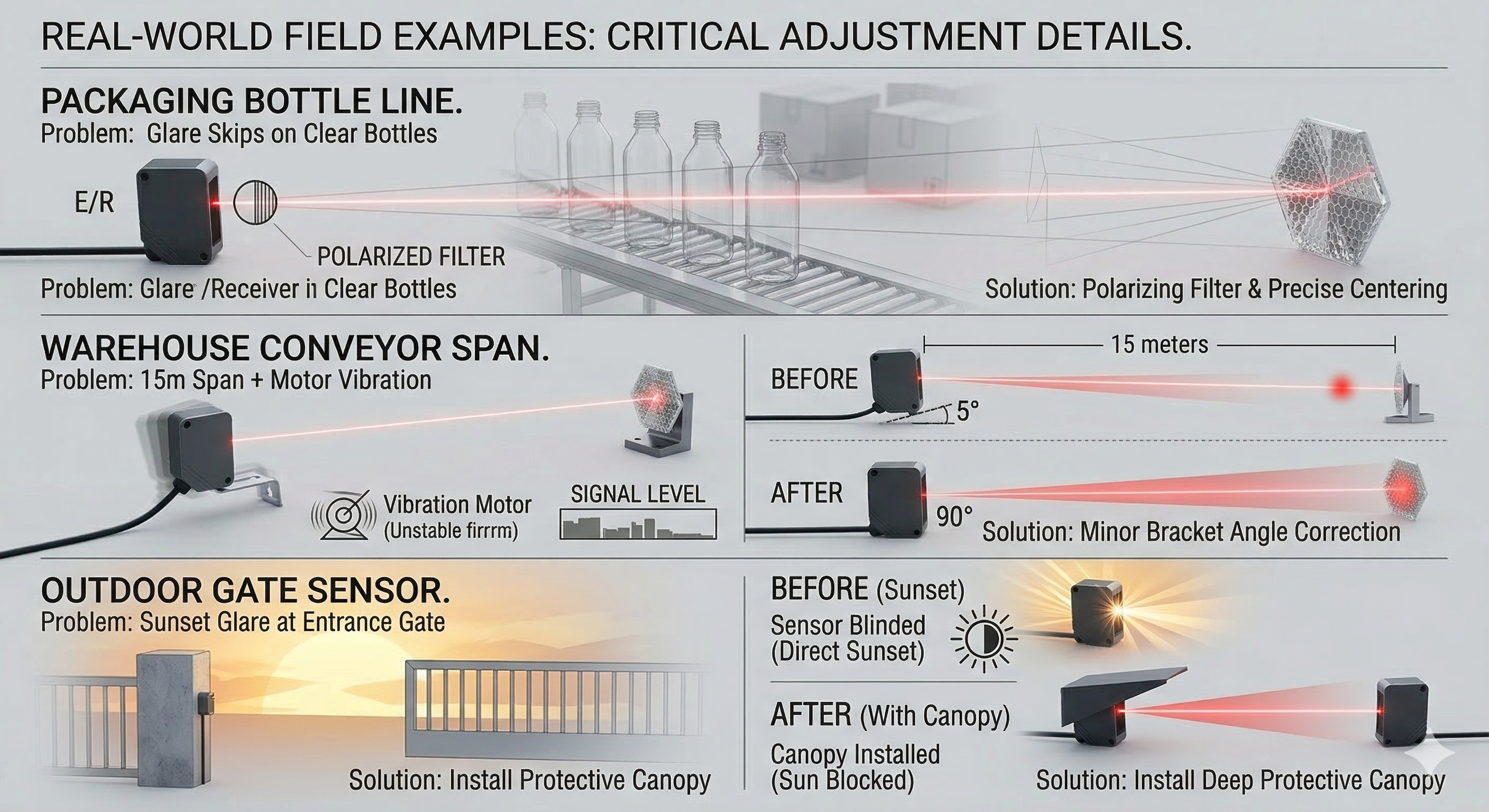
Every production situation is unique, and often it's the smallest adjustment details that decide the fate of an entire conveyor line:
Packaging line bottles. On one line, we were constantly struggling with skips until I replaced the standard sensors with models with a polarizing filter and aligned them precisely in the center of the reflector;
Warehouse conveyor. In one case, on a 15-meter span, the long-distance object detection sensor malfunctioned due to motor vibration, and the problem was only resolved after I adjusted the bracket's misalignment by just a few degrees;
Outdoor gate sensor. At the terminal's entrance gate, the sensor was constantly "blind" at sunset, so I had to install a deep, homemade canopy to prevent direct sunlight from hitting the receiver.
Final Alignment Checklist Before Commissioning
Before assembling the tool and leaving the facility, I always go through this checklist to ensure I won't have to be called in to redo it:
Confirm secure mechanical mounting. I check every bolt and bracket to ensure the base is securely fastened and won't come loose from an accidental impact or vibration;
Verify a strong, stable signal indicator. I monitor the indicator when the line is empty: it should be steady and at maximum power, without the slightest sign of flickering;
Test at full production speed. I run the product through the conveyor at maximum speed to confirm that the electronics can detect and "catch" each object;
Check detection at min/max distance. I always check that the sensor detects an object close to the lens and at the far edge of the work zone to eliminate "blind spots";
Validate the operation under vibration. I start all adjacent equipment and check the signal under real vibration conditions on the shop floor, with all systems operating at full power;
Document position and teach settings. I record the physical position of the sensor and record the settings (teach settings) in a log so that any technician can quickly restore the system after replacement.
FAQs About Photoelectric Sensor Alignment
1. Why does my long-range photoeye occasionally miss objects?
This is a classic sign of poor alignment. The beam is at the edge of the target, and any vibration will cause it to drift.
2. How much signal margin should I leave?
I try to achieve a margin of 3-5x for clean areas and 10-20x for dirty areas.
3. Why does alignment drift over time?
This is mainly due to vibration, which loosens fasteners, or due to deformation of the building floor or walls.
4. Do I need a reflector for long range?
If you're not using a transmitter-receiver system, a high-quality reflector is the only way to achieve stability beyond 3 meters.
5. Can vibration cause misalignment?
Yes, this is the number one reason. At long ranges, vibrations of fractions of a millimeter at the base can turn into centimeters at the end of the beam.