Optical vs Magnetic Encoders: Which Technology Is Better?
22.06.2026
Over the years, as an automation and motion control engineer, I've installed, configured, and replaced hundreds of feedback sensors in a wide variety of applications. When production shuts down in the middle of the night due to an axis position failure, there's no time to read theoretical textbooks. At such moments, it's essential to clearly understand the physics of each sensor, its design limitations, and vulnerabilities.
The choice between optical and magnetic technologies is a classic example of a compromise between the desire for perfect accuracy and the need to ensure absolute equipment survivability in real-world factory conditions. This material is an independent industrial encoder comparison compiled based on many years of practical operating experience, failure analysis, and successful industrial equipment modernization projects.
Today we'll cover:
- The main differences between optical and magnetic encoder technologies;
- Which encoder type offers better accuracy, environmental resistance, and long-term reliability;
- Real-world applications in robotics, CNC systems, conveyors, packaging machinery, and heavy industrial equipment;
- How dust, oil, vibration, and temperature affect encoder performance;
- Includes comparison tables, troubleshooting advice, and practical encoder selection tips.
What Is an Encoder?
Industrial encoders convert mechanical motion into electrical signals used for speed, position, and motion control in automated systems.
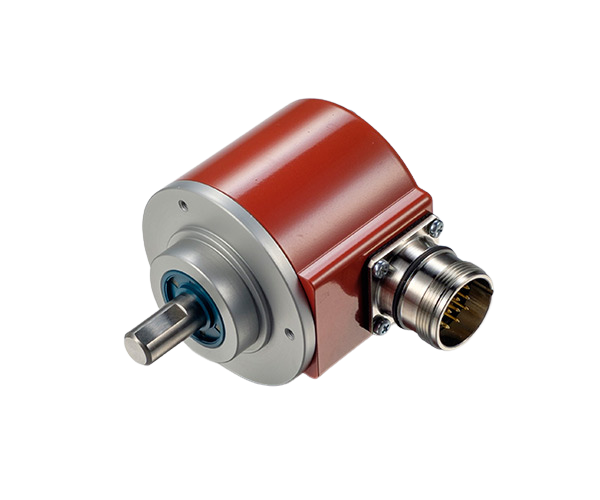
In modern automated systems, this device plays a crucial role as a feedback element, acting as the eyes and ears of the motion controller. Any rotary encoder is designed to continuously monitor the dynamic parameters of rotating equipment components to convert the mechanical rotation of the shaft into a sequence of discrete electrical pulses or digital code. This data is instantly transmitted to PLCs, frequency converters, or servo amplifiers to accurately calculate the current speed, direction of movement, and spatial position of the actuator.
The operation of a modern automated electric drive is unimaginable without these devices. A huge variety of models is available on the market, and you can explore reliable industrial encoders to appreciate the variety of available connection interfaces, design options, and protection classes.
What Is an Optical Encoder?
Optical technology is rightfully considered the gold standard in automation, where the primary requirement is to achieve maximum discreteness and unrivaled signal purity. The design of such a sensor includes three main elements: a directional light source (usually a highly stable infrared LED), a transparent code disk rigidly mounted on the shaft, and a precision photodetector matrix. The code disk is made of special optical glass, quartz, or a thin metal strip using high-precision etching, forming a grid of alternating transparent and opaque microscopic tracks.
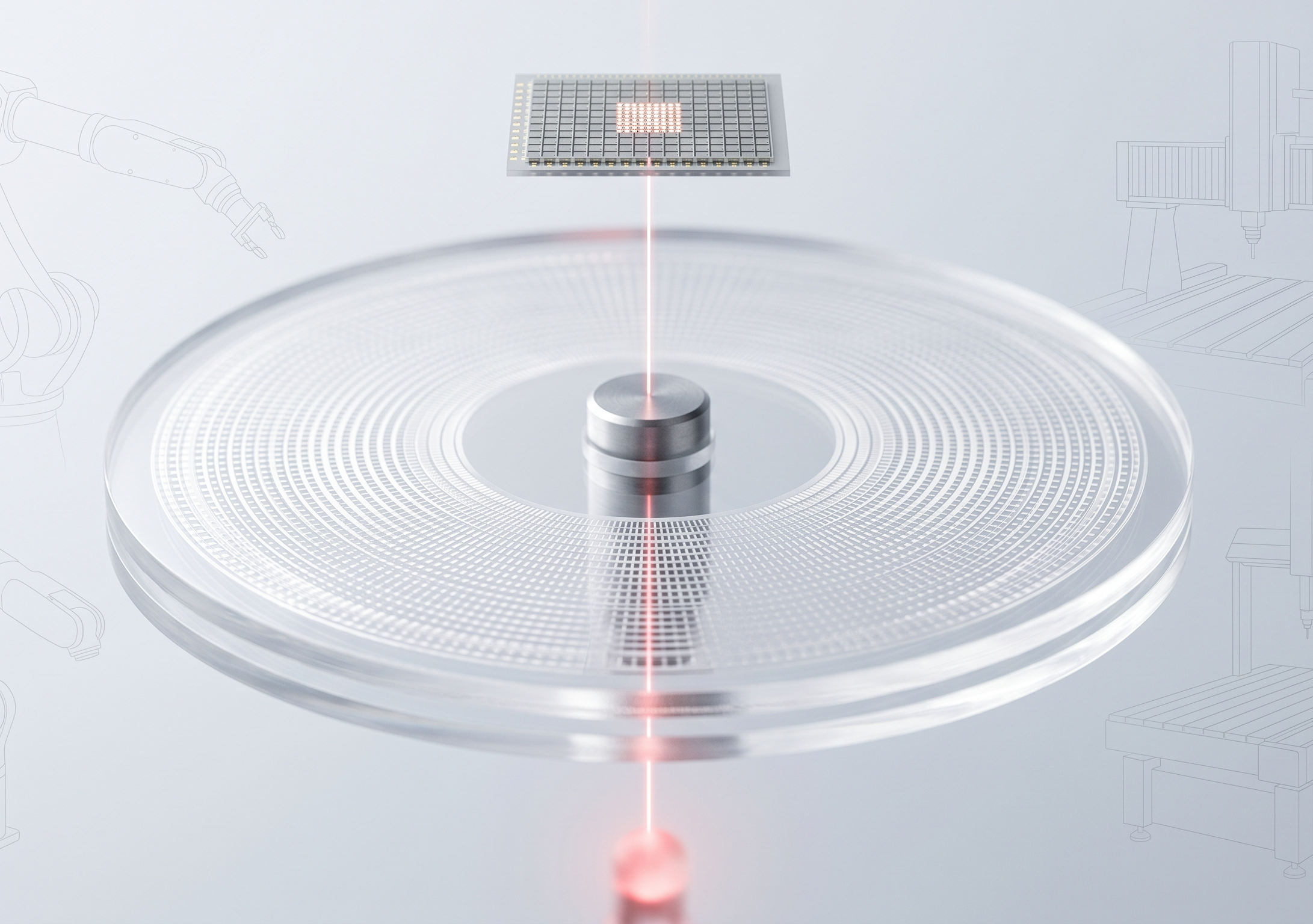
As the shaft rotates, the disk interrupts the light beam, and the photodetector records these changes, generating primary analog signals at the output, which are then digitized by the sensor's internal circuit board. When considering optical encoder advantages, it's important to highlight their phenomenal resolution, measured in millions of pulses per revolution, allowing for the detection of tiny fractions of a degree of angular motion. Optics guarantee perfectly smooth servo drive operation at ultra-low speeds and minimal positioning errors. However, these characteristics come at the cost of high sensitivity to environmental cleanliness: even a microscopic fluff or drop of condensation on an optical disk can completely block light transmission and cause a fatal controller error.
Optical sensors are used in the following areas:
- High-precision CNC machine tools. Monitoring carriage movement and spindle position in precision metalworking;
- Industrial robotics. Ensuring precise trajectory repeatability of multi-axis manipulators;
- Highly dynamic servo systems. Feedback in drives with stringent requirements for response time and speed stability;
- Measuring and laboratory equipment. Coordinate measuring machines, optical tables, and semiconductor manufacturing.
What Is a Magnetic Encoder?
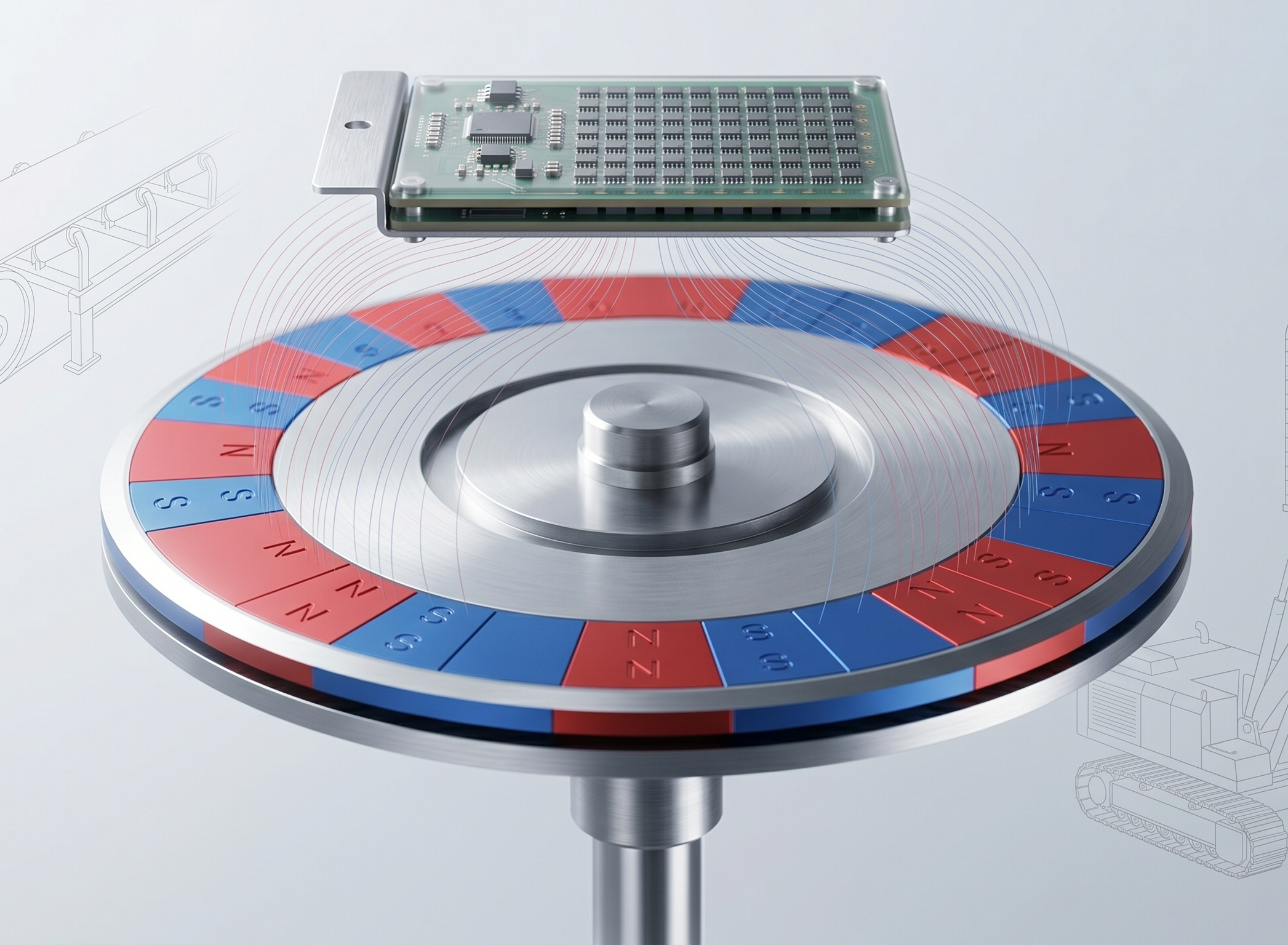
Magnetic measurement systems are based on completely different physical principles, where the presence of light and the transparency of the internal optical channels are completely irrelevant. Inside such a sensor is a multi-pole magnetic rotor (a wheel or disk with alternating north and south poles), mounted on a moving shaft, and a stationary specialized microcircuit containing a matrix of Hall-effect sensors or magnetoresistive elements. As the shaft rotates, the poles move relative to the reading circuit, causing cyclic changes in the surrounding magnetic field. The sensor's electronics record the direction and magnitude of the magnetic induction vector, instantly converting this data into an output pulse or absolute digital signal.
When analyzing the operational advantages of magnetic encoders, their incredible structural resistance to all types of external contamination and mechanical impact always comes first. These sensors have no fragile glass elements that could break from a strong impact, and no microscopic gaps that are vulnerable to dust. The reader board and magnetic disk can be completely encapsulated in a monolithic polymer compound, ensuring excellent hermetic sealing. Naturally, due to physical limitations associated with the width of the magnetic poles and field scattering processes, their native resolution is inferior to optical analogs; however, for most general industrial applications, it is more than sufficient.
Magnetic sensors are indispensable in the following applications:
- Main conveyors and transporters. Belt speed monitoring in highly dusty conditions;
- Heavy industrial equipment. Drilling rigs, mining and processing units, and metallurgical presses;
- Construction and mobile equipment. Outdoor operation at extreme temperatures, exposed to dirt and chemicals;
- Food production. Equipment is subject to regular, aggressive, high-pressure hot water cleaning.
Optical vs Magnetic Encoders – Key Differences
Both encoder technologies work extremely well – but they are designed for very different industrial conditions.
A comprehensive comparison of optical vs. magnetic encoders will help an engineer evaluate the combination of technical and economic factors presented in the table below.
Parameter | Optical Encoder | Magnetic Encoder |
Accuracy | Extremely high (down to arcseconds); perfect for precise sub-micron positioning. | Medium to high; sufficient for most automation, but has a slight interpolation lag. |
Resolution | Up to millions of pulses per revolution for ultra-precise velocity loops. | Limited by the physical spacing of the magnetic poles on the rotor wheel. |
Contamination resistance | Low; highly vulnerable to dust, grease, oil mist, and condensation. | High; completely immune to non-conductive dirt, moisture, and industrial oil. |
Vibration tolerance | Low; heavy shocks can shatter or misalign the internal glass code disc. | High, robust solid-state design easily survives massive mechanical impacts. |
Maintenance requirements | High; requires routine checks on housing seals and coupling alignment. | None; bearingless or encapsulated designs are entirely maintenance-free. |
Environmental durability | Fragile; susceptible to moisture ingress and extreme thermal cycling. | Excellent; works reliably from -40°C to +120°C in washdown or outdoor zones. |
Cost | Higher price point, especially for high-line-count precision systems. | Lower, highly cost-effective option for standard industrial applications. |
Installation sensitivity | Critical; demands strict axial and radial alignment under 0.05 mm. | Low; tolerates minor mechanical tolerances, mounting gaps, and shaft play. |
Accuracy and Resolution Comparison
When we move on to a detailed encoder accuracy comparison, the difference in positioning quality between technologies is the main selection criterion.
Optical encoders:
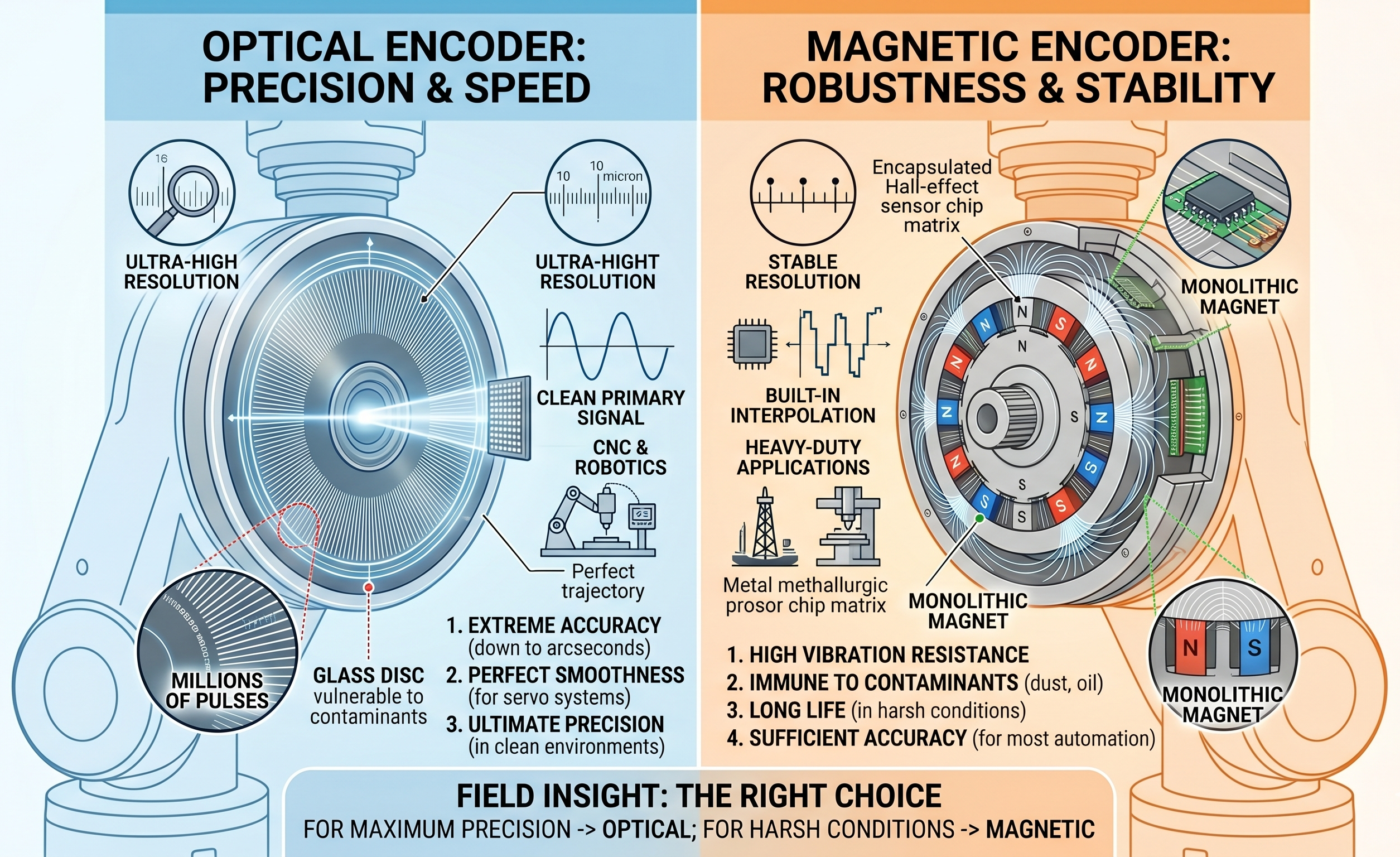
- Pulse count. The properties of the light beam allow for the formation of microscopic code tracks and an extremely high pulse rate per revolution;
- Precise positioning. A clean primary signal does not require complex mathematical noise filtering, ensuring perfect control of dynamic motion;
- CNC application. The ability to maintain a spatial trajectory with micron accuracy makes this technology ideal for precision servo systems.
Magnetic encoders:
- Stable resolution. The encoders operate with a discrete distribution of magnetic poles, resulting in a lower pulse density on the rotor but high stability;
- Sufficient accuracy. The capabilities of the built-in electronic signal interpolation are sufficient for speed and position control of most general industrial automation systems;
- Robustness in conditions. The technology easily tolerates high vibration loads and harsh operating conditions, while maintaining functionality even in situations where a glass disk would shatter.
Field insight: For ultimate precision, optical encoders are impossible to beat. However, in contaminated environments with high vibration levels, magnetic encoders typically last significantly longer.
Environmental Resistance and Reliability
Within a true industrial setting – whether it's in a workshop or outside, a sensor has to put up with an extreme set of conditions. Therefore, very careful consideration has to be given when you're selecting an encoder for harsh environments that will provide reliable operation of the conveyor without constant maintenance and service interruptions.
Optical encoders:
- Sensitivity to contamination. Fine dust, oil mist, and moisture can penetrate the encoder, instantly blocking the light beam, which is why I regularly encountered fatal pulse skips;
- Mechanical vulnerability. Constant vibration of industrial equipment and sudden temperature changes lead to condensation and physical destruction of the fragile glass disc;
- Limitations in harsh environments. In steel mills and processing plants, these devices require constant maintenance, cleaning, and the installation of expensive pressurized enclosures;
- Challenges in outdoor environments. Using them in washdown systems or on outdoor faucets is a huge risk, as the slightest loss of seal integrity will completely disable the unit.
Magnetic encoders:
- Protection from contamination. Magnetic lines of force pass freely through layers of unrefined oil, fuel oil, or sawdust, eliminating the need for the engineer to constantly wipe the sensor;
- Vibration resistance. The design, without moving parts, allows the boards to easily withstand the harsh impacts of heavy machinery without losing signal stability;
- Work in harsh environments. For me, this is the best encoder, as the fully encapsulated rotor operates for years in harsh chemicals and hot metal splashes;
- Outdoor use. Mobile automation, port terminals, and outdoor conveyors operate without interruption, despite frost, icing, or direct high-pressure water washing.
Speed and Dynamic Performance
The dynamic characteristics of a sensor determine its ability to adequately respond to instantaneous changes in the rotational speed of actuators. Modern industrial motion feedback systems require devices to detect rotation and transmit accurate data to the control loop with the shortest possible delay.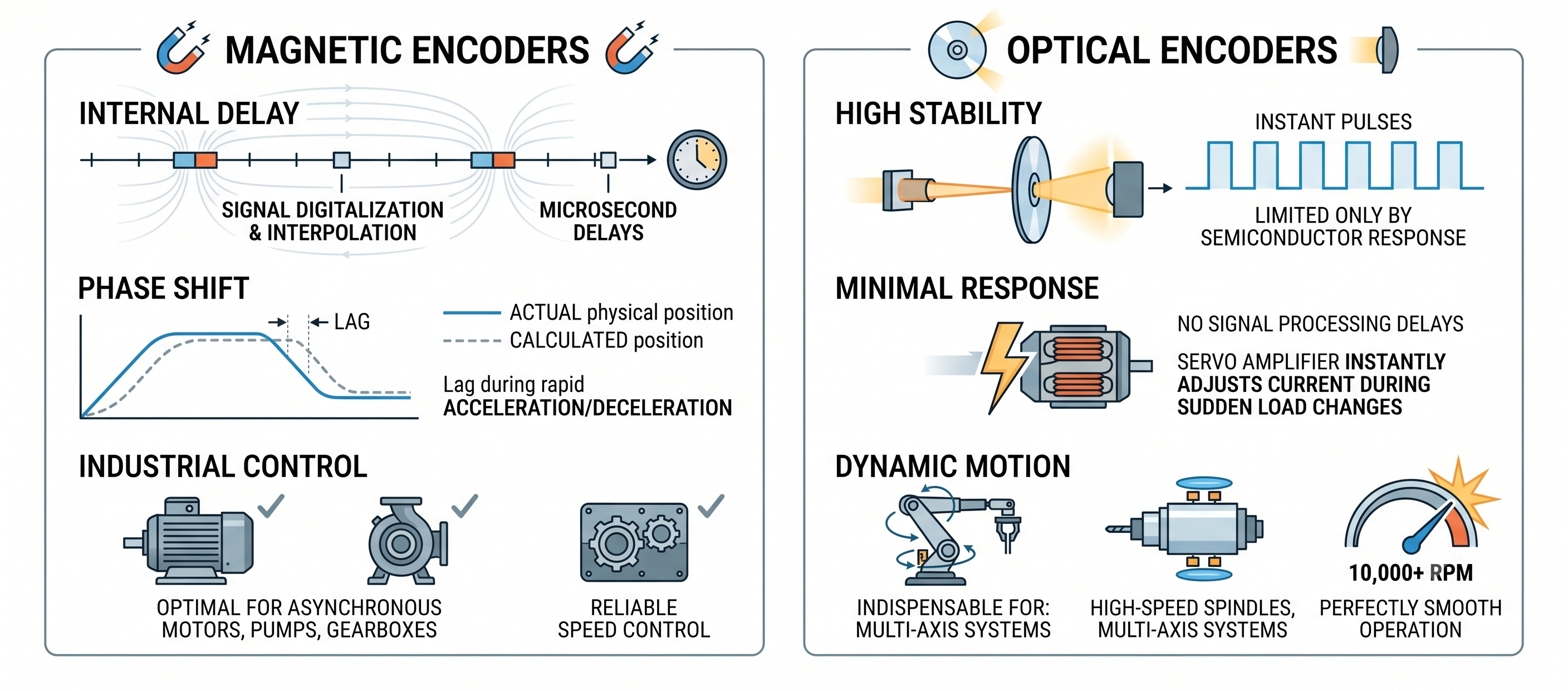
Magnetic encoders:
- Internal delay. The process of digitalizing signals from Hall elements and software interpolation inevitably introduce microsecond delays into the feedback loop;
- Phase shift. During extremely rapid acceleration or deceleration, the calculated position may lag slightly behind the actual physical position of the shaft;
- Industrial control. The sensor characteristics are optimal for reliable speed control of most standard asynchronous motors, pumps, and gearboxes.
Optical encoders:
- High stability. The sensors generate pulses almost instantly, since the speed of detecting changes in illumination is limited only by the response time of the underlying semiconductor junctions;
- Minimal response. The absence of delays in signal processing allows the servo amplifier to instantly adjust the current in the motor windings during sudden load changes;
- Dynamic motion. This technology is indispensable for high-speed spindles and multi-axis systems that require perfectly smooth operation at speeds exceeding 10,000 rpm.
Installation and Maintenance Differences
Proper encoder installation and maintenance minimize the risk of sudden equipment failure and reduce the total cost of ownership.
Optical encoders:
- Alignment accuracy. Requires perfect alignment and strict adherence to tight mechanical tolerances, as even minimal radial or axial shaft play will distort the signal;
- Cleanliness during installation. Installation must be carried out in an absolutely clean environment, as any contamination of the internal optical elements before the housing is completely sealed guarantees rapid failure;
- Vibration isolation of the unit. Due to the high fragility of the encoder glass, it is critical to use special compensating couplings to effectively dampen mechanical shock;
- Cable routing and shielding. The high frequency of output pulses requires the use of high-quality shielding and the installation of signal lines separate from the motor power circuits.
Magnetic encoders:
- Easy to install. Mounting is very easy because it doesn’t need to be perfectly aligned or have very little tolerance for installation error;
- No maintenance required. There are no wear items to check on both the non-contact designs and any type of built-in bearing. Therefore, there is no required maintenance since there is no wear;
- Resistant to misalignment. The sensor can be accurately measured with respect to axial runout and also withstands heavy vibration without any type of complex vibration isolation;
- Protected from interference. The sensor has unique requirements for shielding from large external magnetic field areas, but is more resistant to standard electrical interference than other sensor technologies.
Real-World Industrial Applications
Over the years, I've realized one simple thing: sensor data sheets are often written for ideal laboratory conditions. In reality, engineers have to make decisions based on how many shifts a sensor can last before its first failure and how critical a single second of signal loss is for the safety of the entire line.
CNC machines
On a five-axis milling machine for precision molds, the slightest error resulted in defects. I installed high-resolution optical encoders directly on the servomotor shafts. The physics of the light beam ensured flawless microstepping and perfect positioning accuracy during reversals, which would have been completely unattainable with magnetic encoders.
Conveyor systems
At a cement plant, the main conveyor was constantly stalling due to speed fluctuations: cement dust managed to penetrate under any seals and clog the optics within a couple of weeks. I replaced these devices with contactless magnetic encoders. When I attached the magnet to the drive drum shaft and the reader to the frame, I achieved 100% resistance to continuous vibration and dust, eliminating downtime.
Robotics
In an automated welding project, there was a situation where the torch must be guided around a complex spatial trajectory by the manipulator arm of the robot. Because of how there is a high likelihood of burn-through of the thin metal if there is a sudden jerk in motion, I used compact optical microzoemployers integrated into each of the servo drives of all of the joints of the robots. They provide millions of pulses per revolution and provide a perfect instantaneous speed controller response and absolute repeatable performance.
Heavy industrial equipment
I was rebuilding the hoisting system of a ladle crane in a rolling mill. The conditions there are extreme: intense heat from molten steel, conductive graphite dust, and the harsh impacts of lifting a multi-ton load. The optical glass would have shattered on the very first lift. I chose a heavy-duty magnetic encoder in a cast steel case with electronics completely encapsulated in a compound that can withstand these hellish loads without any problems.
Common Problems and Troubleshooting
Even the most reliable equipment malfunctions over time. A comprehensive analysis of magnetic encoder vs. optical encoder malfunctions in the field will help us identify clear warning signs and operational diagnostic methods for each type of device.
Optical encoder issues:
- Optical disk contamination. Dust, condensation, or oil mist blocks the light from the LED, resulting in jerking motion and a gradual accumulation of positional error. Field correction requires careful cleaning of the glass with isopropyl alcohol;
- Shaft alignment errors. Poor coupling alignment causes a characteristic mechanical grinding noise and strong vibration during rotation. To prevent disk damage, immediately check the radial runout and replace the deformed coupling;
- Measured signal interruption. Erratic axis resets or a sudden PLC shutdown indicate a broken wire in the moving cable or degradation of the internal LED. The problem is localized by checking the pulse shape and amplitude with an oscilloscope.
Magnetic encoder issues:
- Power grid electro-magnetic interference. Interference from high-frequency transmission lines in proximity creates noise and causes position-speed-related spurious jumps in the closed-loop control system. This fault condition is controlled by providing a single-point ground for the cable shield at the PLC cabinet side;
- Positioning accuracy deterioration. The resolution is ultra-high, and at a very rapid reverse shaft motion, the system can begin to drift because of the delay in the internal mathematical interpolation of the signal. To prevent this symptom from occurring, you can either decrease acceleration dynamics or use a sensor with a narrower pole-pitch;
- Mounting gap instability. When the motor bearings have axial movement due to wear or when bracket fasteners are not tight, the distance between the magnet and the reading device changes and results in total loss of communication between the units. Calibration of the sensor's position relative to the reading device using feeler gauges will correct for this fault condition.
How I Choose Between Optical and Magnetic Encoders
In engineering practice, I never select a sensor based on catalogs. My personal encoder selection guide is always based on a rigorous assessment of shop floor realities, where any factor can cause a sudden line stop:
- Environmental priority. In a dusty packaging plant or sawmill, it's better to sacrifice resolution than constantly struggle with disk contamination;
- Positioning accuracy. For precision multi-axis machines and servo drives, I choose optics that guarantee micron coordinates;
- Rotation speed. At speeds above 10,000 rpm, optical models benefit from the instantaneous response of the photo sensor;
- Shop vibration level. For heavy stamping presses, fragile optical glass is unsuitable, so I install a monolithic magnetic system;
- Maintenance accessibility. In hard-to-reach machine components, I install a contactless magnetic model, which eliminates the need for service;
- Balancing budget and performance. I don't overpay for expensive optical resolution, where a simple sensor is enough to control the speed of a regular pump.
Which Encoder Technology Is Better?
Neither encoder technology is universally better – the right choice depends on the required precision, environmental conditions, and machine design.
Optical instruments remain unrivaled leaders in the precision segment, where maximum resolution, instantaneous response, and impeccable motion dynamics are critical.
Magnetic systems firmly hold the lead in the general industrial and heavy-duty segments, where structural durability, dirt-resistant performance, ease of installation, and lack of regular maintenance are paramount.
Future Trends in Encoder Technology
Advances in microelectronics and digital signal processing algorithms are gradually blurring the lines between these two competing technologies. A modern encoder technology comparison reveals that magnetic sensor manufacturers have made significant advances. Here are some trends to look forward to:
- High-resolution magnetic encoders. Advances in interpolation algorithms are rapidly bringing the accuracy of magnetic sensors closer to the capabilities of optical systems;
- Miniaturization. Reducing the size of circuit boards and magnetic chips allows sensors to be integrated into ultra-compact robotic assemblies and joints;
- Built-in diagnostics. Devices can independently monitor their own wear, contamination levels, and signal quality before failure;
- Industry 4.0 integration. Support for modern network protocols enables direct transmission of telemetry data to cloud monitoring services;
- Smart feedback. Embedded microprocessors allow sensors to compensate for mechanical play and calibrate the signal on the fly.
FAQs About Optical and Magnetic Encoders
1. What is the difference between optical and magnetic encoders?
Optical encoders use a light beam and a slotted glass disk, while magnetic encoders use Hall sensors and a rotating multi-pole magnet.
2. Which encoder is more accurate?
Optical. It provides submicron accuracy and delivers millions of pulses per revolution without software interpolation delays.
3. Are magnetic encoders better for dirty environments?
Yes. The magnetic field passes freely and without distortion through layers of grease, oil, water, chips, and non-conductive dirt.
4. Why do optical encoders fail in dusty conditions?
Dust penetrates the housing, settles on the code disk, and physically blocks the light from the LED to the photodetector.
5. Which encoder is better for CNC machines?
Optical. For precision axes and spindles of CNC machines, maximum signal purity and positioning accuracy are critical.
6. Can magnetic encoders replace optical encoders?
Yes, in most general industrial applications (conveyors, pumps, heavy machinery), where extreme resolution is a secondary concern for reliability.